Christian
Creation for Adults - Encyclopaedia Book 18
What does the extraordinary complexity of life reveal about its origin?
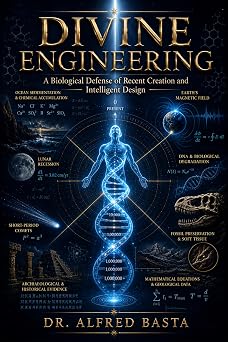
In Divine Engineering, Dr. Alfred Basta presents a comprehensive biological and theological case for Intelligent Design and recent creation, examining the remarkable systems, structures, and information that make life possible. Drawing from biology, biochemistry, mathematics, information theory, engineering, and Scripture, this book challenges the assumption that the complexity of living organisms can be adequately explained through unguided evolutionary processes.
Beginning with the concepts of irreducible complexity and specified complexity, Dr. Basta explores how biological systems depend upon precisely coordinated components and highly organized information. The discussion then moves deep inside the cell to examine molecular machines such as ATP synthase, the bacterial flagellum, the ribosome, DNA replication machinery, kinesin, and the spliceosome.
The investigation expands to the system level, examining the remarkable coordination of the circulatory, respiratory, nervous, reproductive, and immune systems. It then considers the precision of specialized organs and biological capabilities, including vision, hearing, the human hand, echolocation, electroreception, and the neurological systems that allow organisms to interact with their environments.
The book also explores biomimetics, showing how engineers study and imitate biological mechanisms such as gecko adhesion, optical structures, and avian flight. These examples are presented as evidence of the extraordinary engineering principles embedded within living systems.
Finally, Divine Engineering addresses common arguments concerning so-called “bad design,” including vestigial organs, the recurrent laryngeal nerve, the panda’s thumb, the vertebrate retina, and “junk DNA.” The book argues that advances in biological research increasingly reveal functionality and optimization where earlier interpretations assumed evolutionary remnants.
Bringing these scientific observations together with biblical interpretation, Dr. Basta argues that the complexity and information found throughout nature are consistent with a purposeful Creator and the recent creation framework described in Genesis. The result is an unapologetic defense of Intelligent Design, biblical creation, and the proposition that the living world bears the unmistakable signature of its Divine Engineer.
For readers interested in creation science, Intelligent Design, biology, Christian apologetics, biblical creation, evolution, and the intersection of science and Scripture, Divine Engineering offers an extensive exploration of one of humanity’s most fundamental questions: How did life, with all of its extraordinary complexity and precision, come to exist?