Apologetics
Creation for Adults - Encyclopaedia Book 19
What if the fundamental laws of physics point beyond the universe itself?
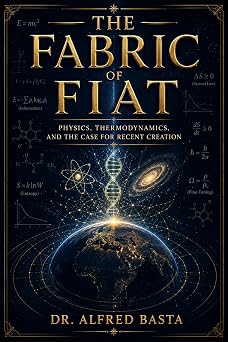
In The Fabric of Fiat, Dr. Alfred Basta examines the deepest questions surrounding the origin, structure, and purpose of the cosmos through the combined lenses of physics, thermodynamics, information theory, mathematics, chemistry, and biblical theology.
Beginning with the First and Second Laws of Thermodynamics, Basta explores the origin and conservation of energy, entropy, the arrow of time, and the implications of a finite cosmic past. He then turns to the extraordinary informational complexity of biological systems, examining why the genetic code and functional machinery of life cannot, in his argument, be adequately explained by thermodynamic processes alone.
The book goes further into the origin and uniformity of natural law, asking why the universe is governed by consistent mathematical principles and why those principles are so remarkably intelligible to the human mind. It examines the fine tuning of fundamental forces and cosmological constants, including gravity, electromagnetism, nuclear forces, the cosmological constant, particle mass ratios, and the expansion rate of the universe.
Basta also critically examines proposed naturalistic explanations such as the anthropic principle, multiverse theories, quantum fluctuations, and the concept of a universe arising from “nothing.” The discussion distinguishes a true philosophical nothing from a physical quantum vacuum and considers the causal and philosophical assumptions underlying modern cosmological models.
The investigation then moves from the vast scale of cosmology to the chemistry of life, exploring the remarkable properties of carbon, water, phosphorus, nitrogen, and other essential elements, as well as questions surrounding Big Bang and stellar nucleosynthesis.
At the heart of The Fabric of Fiat is a unified thesis: the mathematical order of nature, the fine tuning of physical constants, the informational architecture of living systems, the habitability and discoverability of Earth, and the laws governing matter and energy are presented as cumulative evidence for an intelligent, purposeful Creator and a recently created universe.
For readers interested in Christian apologetics, creation science, cosmology, physics, intelligent design, philosophy of science, and the relationship between scientific discovery and biblical faith, this book offers a detailed and intellectually ambitious examination of one of humanity’s oldest questions:
Why is there a universe at all, and what does its remarkable order tell us about its origin?