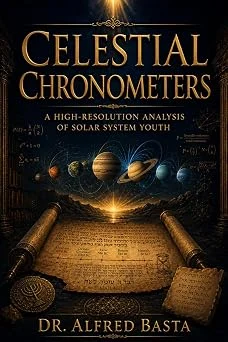
Celestial Chronometers: A High-Resolution Analysis of Solar System Youth
Creation for Adults - Encyclopaedia Book 8
What if the planets themselves are keeping time?
Read the Full Overview
In Celestial Chronometers, Dr. Alfred Basta presents a comprehensive examination of the solar system through the lens of astronomy, physics, thermodynamics, and planetary science. Drawing from decades of scientific research, he analyzes magnetic fields, planetary rotation, internal heat, comets, Saturn’s rings, lunar recession, methane on Titan, volcanic activity on Io, and numerous other celestial phenomena to argue that many observed characteristics of our solar system are more consistent with a recent creation than with billions of years of evolutionary history.
Each chapter investigates major astronomical observations, evaluates prevailing scientific models, and presents an alternative interpretation rooted in a biblical creation framework. Rather than relying on philosophical arguments alone, the book emphasizes measurable physical processes, predictive models, and empirical observations while challenging readers to critically examine commonly accepted assumptions about the age and origin of the solar system.
Whether you are a Christian, student, educator, researcher, pastor, or anyone interested in the intersection of science and faith, Celestial Chronometers offers an in-depth exploration of one of the most debated questions in science:
How old is our solar system—and what does the evidence actually reveal?
Inside you’ll discover:
- Planetary magnetic field decay and its chronological implications
- Earth, Mercury, Uranus, Neptune, and Ganymede as “celestial clocks”
- The thermodynamics of the gas giants
- Lunar recession and satellite dynamics
- Comets, Saturn’s rings, and interplanetary dust
- The Faint Young Sun Paradox
- Exoplanets, angular momentum, and challenges to conventional formation theories
- A scientific discussion from a biblical creation perspective
Thought-provoking, meticulously researched, and extensively documented, Celestial Chronometers invites readers to explore the universe through a different scientific perspective while engaging one of the most important questions about our origins.
What is Celestial Chronometers about?
Celestial Chronometers asks what if the planets themselves are keeping time. It examines the solar system through astronomy, physics, thermodynamics, and planetary science and argues that many observed features fit a recent creation better than billions of years of history. Topics include the decay of planetary magnetic fields, Earth, Mercury, Uranus, Neptune, and Ganymede as celestial clocks, the internal heat of the gas giants, lunar recession and satellite dynamics, comets, Saturn’s rings, interplanetary dust, the Faint Young Sun Paradox, exoplanets and angular momentum, methane on Titan, and volcanic activity on Io. Each chapter examines a major observation, evaluates the prevailing model, and offers an alternative interpretation within a biblical creation framework, with emphasis on measurable processes and empirical data.
Who wrote Celestial Chronometers?
It was written by Alfred Basta, a professor, author, and musician.
What genre is Celestial Chronometers?
It is Christian apologetics and creation science focused on astronomy, which means it argues from measurable physical processes in the solar system rather than from philosophy alone.
Who is Celestial Chronometers for?
It is for Christians, students, educators, researchers, pastors, and anyone interested in the relationship between science and faith.
Is Celestial Chronometers part of a series?
Yes. It is Book 8 of Creation for Adults, Encyclopaedia. You can find the series on Amazon.
Where can I buy Celestial Chronometers?
Celestial Chronometers is available in paperback, hardcover and Kindle editions. The hardcover ISBN-13 is 979-8186500162 (299 pages, published July 9, 2026).
Amazon (paperback) | Amazon (hardcover) | Amazon (Kindle) | Indigo (author page)
More Questions About Celestial Chronometers
Celestial Chronometers covers the age of the solar system as examined through astronomy, physics, thermodynamics, and planetary science. Its topics include planetary magnetic field decay, Earth, Mercury, Uranus, Neptune, and Ganymede as celestial clocks, the thermodynamics and internal heat of the gas giants, planetary rotation, lunar recession and satellite dynamics, comets, Saturn’s rings, interplanetary dust, methane on Titan, volcanic activity on Io, the Faint Young Sun Paradox, and exoplanets, angular momentum, and challenges to conventional formation theories.
Readers of Celestial Chronometers will learn why the author argues that many observed characteristics of the solar system are more consistent with a recent creation than with billions of years of history. The book explains how magnetic fields, internal heat, orbital dynamics, and short-lived features such as comets and Saturn’s rings can act as clocks, what the prevailing scientific models say about each, and where those models face difficulties. Readers are challenged to examine commonly accepted assumptions about the age and origin of the solar system.
Celestial Chronometers is organized chapter by chapter around major astronomical observations. Each chapter investigates one set of phenomena, such as magnetic field decay, the heat of the gas giants, lunar recession, comets, or the Faint Young Sun Paradox, evaluates the prevailing scientific models for it, and then presents an alternative interpretation rooted in a biblical creation framework. Throughout, the emphasis falls on measurable physical processes, predictive models, and empirical observations rather than on philosophical arguments alone.
Celestial Chronometers is a good fit for readers interested in astronomy and planetary science who want to see those fields engaged from a biblical creation perspective. It is described as meticulously researched and extensively documented, and it works through planets, moons, comets, rings, and the sun with attention to measurable processes and empirical data. Christians, students, educators, researchers, and pastors interested in the meeting of science and faith are all named as intended readers.
About the author: Alfred Basta is a professor, author of Ward No. 8 and The Malgrave Letters, and musician as The Bastas Project.
Last updated: October 23, 2026