Christian
What if the ground beneath your feet could tell you whether the Bible is telling the truth?
In Digging Up the Bible, young readers become archaeological detectives and travel deep into the ancient world to uncover fascinating discoveries connected to Scripture. From buried cities and ancient tablets to royal inscriptions, coins, pottery, tombs, and mysterious scrolls, each discovery reveals another piece of the world described in the Bible.
Explore the rediscovery of the Hittites, once dismissed by critics as a biblical invention. Discover how ancient tablets revealed the true identity and role of Belshazzar, king of Babylon. Examine the famous Pilate Stone and learn how it confirmed the existence and official title of Pontius Pilate. Travel to Jericho, investigate the Dead Sea Scrolls, explore the world of King David, and uncover archaeological evidence connected to the days of Jesus.
This book explains archaeology in a way young readers can understand while showing how archaeologists investigate the past through excavation, pottery, inscriptions, coins, written records, and layers of ancient cities. It also explains an important lesson about evidence: archaeology can confirm many historical details of the Bible, while some questions remain matters of faith.
Each chapter includes engaging features designed to turn learning into an adventure:
– Bible verses and Big Idea summaries
– Fascinating “Did You Know?” facts
– Kid friendly vocabulary
– Think and Talk discussion questions
– Hands on archaeology activities
– Memory verses
– Chapter quizzes and an answer key
– A glossary of important terms
– Coloring pages
Digging Up the Bible is more than a book about ancient ruins. It is an invitation to explore history, archaeology, Scripture, and faith together. For curious young readers who love discovering how the ancient world connects with the Bible, every chapter offers another opportunity to dig deeper and see what the evidence reveals.
Open the book, grab your imaginary archaeological brush, and start digging. The stones have a story to tell.
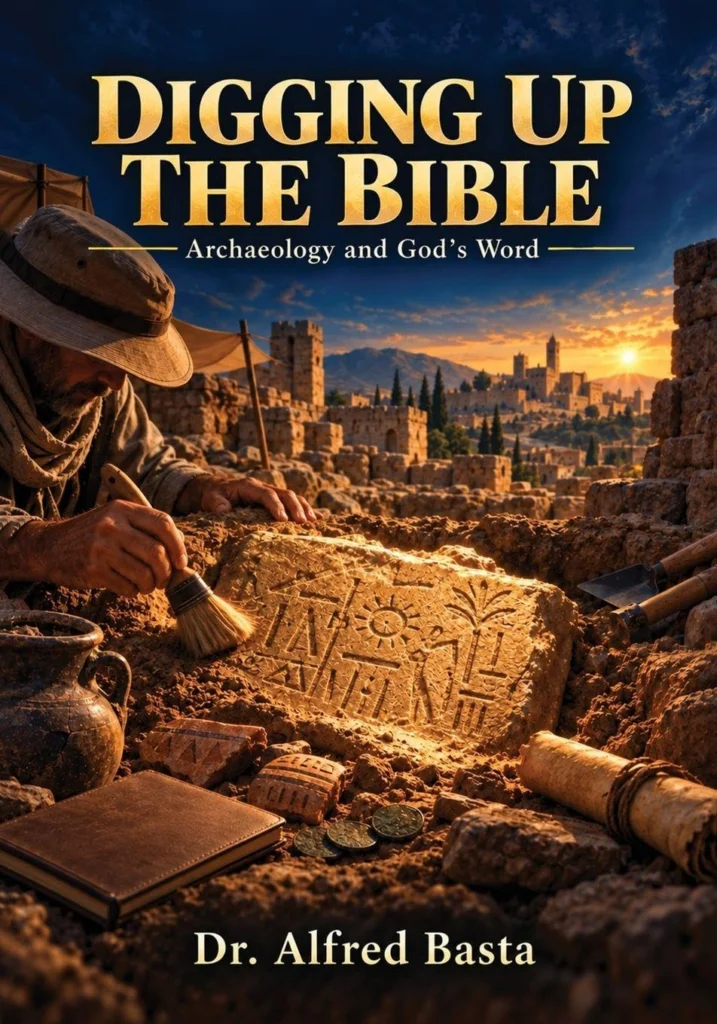
Digging Up The Bible: Archaeology and God’s Word is about how archaeology connects with the Bible, written for young readers. It explores the rediscovery of the Hittites, the ancient tablets that revealed the identity of Belshazzar, the Pilate Stone that confirmed Pontius Pilate’s existence and title, the city of Jericho, the Dead Sea Scrolls, the world of King David, and evidence from the days of Jesus. The book shows how archaeologists investigate the past and what their findings reveal about Scripture.
Digging Up The Bible was written by Alfred Basta, a professor, author and musician who has written more than 200 books. He wrote it as part of Foundations of Creation, his series for young readers examining the case for biblical accuracy, and in this volume he explains archaeology in a way children can understand while showing how excavations, inscriptions, coins, and written records have confirmed many historical details of the Bible.
Digging Up The Bible is Christian nonfiction for young readers that introduces biblical archaeology. It works as an interactive learning book rather than a straight narrative, with each chapter offering Bible verses, Big Idea summaries, fascinating facts, kid-friendly vocabulary, discussion questions, hands-on activities, memory verses, and quizzes. The book combines history, archaeology, Scripture, and faith in a format designed to turn learning into an adventure for curious children.
Digging Up The Bible is for curious young readers who love discovering how the ancient world connects with the Bible. It suits children who enjoy history and adventure, along with the parents and teachers who guide them, since each chapter includes discussion questions, activities, quizzes with an answer key, and coloring pages. Readers who want to see how excavation, pottery, inscriptions, and coins confirm biblical details will find every chapter an invitation to dig deeper.
Digging Up The Bible is part of Foundations of Creation: An Encyclopedia Examining the Scientific Case for Biblical Accuracy, Alfred Basta’s series for young readers. Its companion volumes include The Bible, Is It Really True? and Reading Genesis The Way God Wrote It. Each volume stands on its own, so a child can read Digging Up The Bible by itself, but together the books build a case for trusting Scripture from archaeology, history, and the text of Genesis.
Digging Up The Bible covers the rediscovery of the Hittites once dismissed as a biblical invention, the tablets that identified Belshazzar as king of Babylon, the Pilate Stone, Jericho, the Dead Sea Scrolls, the world of King David, and archaeological evidence from the time of Jesus. It also explains how archaeologists work with excavation, pottery, inscriptions, coins, written records, and the layers of ancient cities, and it discusses what evidence can and cannot prove.
Readers of Digging Up The Bible will learn how archaeology has confirmed many historical details of the Bible, from the existence of the Hittites to the official title of Pontius Pilate. They will learn how archaeologists investigate the past through excavation, pottery, inscriptions, coins, and written records. They will also learn an important lesson about evidence: archaeology can confirm much of biblical history, while some questions remain matters of faith.
Digging Up The Bible is organized into chapters, each built around a discovery or site such as the Hittites, Belshazzar, the Pilate Stone, Jericho, or the Dead Sea Scrolls. Every chapter includes Bible verses, Big Idea summaries, “Did You Know?” facts, kid-friendly vocabulary, Think and Talk discussion questions, hands-on archaeology activities, memory verses, and a quiz. The book closes with an answer key, a glossary of important terms, and coloring pages.