Christian
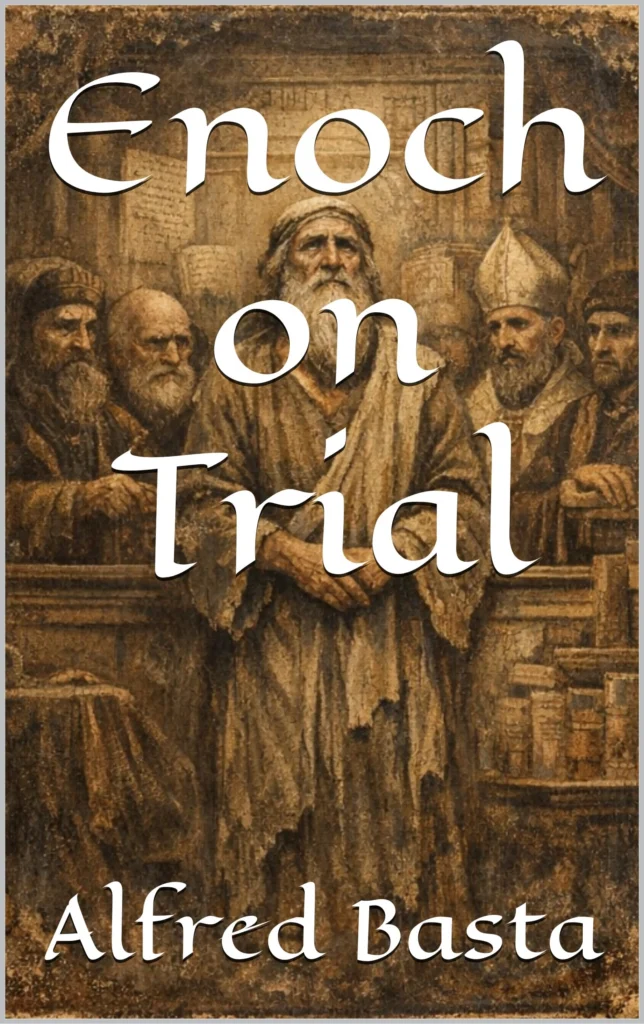
From the shadows of ancient manuscripts to the heated debates of early Church councils, the Book of Enoch has long haunted the margins of sacred Scripture — captivating mystics, confounding scholars, and challenging the boundaries of divine authority.
Enoch on Trial argues that the early Church was right to exclude the Book of Enoch from the biblical canon, and presents this as a systematic case rather than a neutral survey. The argument draws on the critiques of Jerome and Augustine, the silence of the canonical tradition, and the claim that Enochic authorship is historically implausible. The book addresses the puzzling reference in Jude 1:14 to 15 and argues that Enoch’s angelology conflicts with the teachings of Jesus. Its larger themes are canonicity, the boundaries of scriptural authority, and the status of apocryphal and pseudepigraphal literature. The hardcover runs 188 pages.
It was written by Alfred Basta, a professor, author, and musician.
It is a work of theology and biblical studies, which means it builds a reasoned argument from historical and textual evidence about what belongs in the canon.
The description does not name a specific audience. It suits readers interested in debates over the biblical canon and the Book of Enoch.
No. Enoch on Trial is a standalone book. A related title by the same author is The Apocrypha: A Scriptural Examination.
Enoch on Trial is available in hardcover and Kindle editions. The hardcover ISBN-13 is 979-8257736414 (286 pages, published April 17, 2026).
Amazon (hardcover) | Amazon (Kindle) | Indigo (author page)
Enoch on Trial covers the case against the Book of Enoch as Scripture. It examines the formidable critiques of Jerome and Augustine, the silence of the canonical tradition, and the historical impossibility of Enochic authorship. It also treats the enigmatic reference in Jude 1:14-15 and the troubling angelology of the Book of Enoch, which the author argues stands in direct contradiction to the teachings of Jesus. Each pillar supporting the book’s claim to authority is tested in turn.
Readers of Enoch on Trial will learn why the early Church excluded the Book of Enoch from the sacred canon and why the author believes that decision was right. They will understand what Jerome and Augustine said against the book, why the silence of the canonical tradition matters, why Enoch himself could not have written it, how to read the reference in Jude, and where its angelology conflicts with the teachings of Jesus.
Alfred Basta treats the Book of Enoch as a defendant on trial, examining every pillar of its claimed authority with what the description calls unflinching rigor and theological precision. Rather than offering a neutral survey of a text that has captivated mystics and confounded scholars, Enoch on Trial mounts a systematic argument built from the critiques of Jerome and Augustine, the canonical tradition, the question of authorship, and the book’s conflict with the teachings of Jesus.
Enoch on Trial answers whether the Book of Enoch belongs in the Bible and why the early Church said it did not. It asks what Jerome and Augustine found wrong with the book, why the canonical tradition stayed silent about it, whether the patriarch Enoch could have written it, what the reference in Jude 1:14-15 does and does not prove, and whether its angelology can be reconciled with the teachings of Jesus.
About the author: Alfred Basta is a professor, author of Ward No. 8 and The Malgrave Letters, and musician as The Bastas Project.
Last updated: October 23, 2026