Apologetics
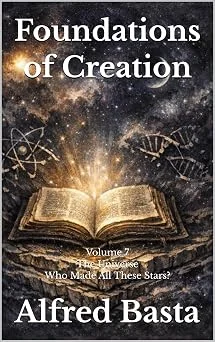
An Encyclopedia Examining the Scientific Case for Biblical Accuracy: Volume 7: The Universe: Who Made All These Stars?
The universe is not an accident — it is an announcement. In this sweeping volume of Foundations of Creation, young readers are taken to the outer edges of space and brought face to face with the most fundamental question in all of science: where did everything come from? Beginning with the logical case that everything which begins to exist must have a cause, and that the universe clearly began to exist, this book walks readers through the serious scientific problems with the Big Bang — including the horizon problem, the missing antimatter, and the mysterious “dark matter” and “dark energy” that scientists have never actually detected but need to make their equations balance. The famous starlight problem — how we can see distant stars if the universe is young — is addressed honestly and thoughtfully, with several creationist models explained in accessible language, including insights drawn from Einstein’s relativity. Brand-new images from the James Webb Space Telescope, showing fully formed galaxies where evolutionary models predicted only “baby” galaxies, are examined as powerful evidence for a young universe. The book closes with the breathtaking fine-tuning of the cosmos — dozens of physical constants set with razor-sharp precision for life to exist — pointing with undeniable force to a Designer. The heavens declare the glory of God.
Foundations of Creation Volume 7 asks where the universe came from and argues that anything that begins to exist must have a cause. It presents difficulties for the Big Bang model, including the horizon problem, the missing antimatter, and the fact that dark matter and dark energy have never been directly detected. The book then takes up the distant starlight question and explains several creationist models in accessible language, including ideas drawn from Einstein’s relativity. It examines James Webb Space Telescope images of fully formed early galaxies and presents them as evidence for a young universe. The closing chapter looks at dozens of physical constants that appear precisely set for life and points to a Designer, ending with the words of Psalm 19: the heavens declare the glory of God.
It was written by Alfred Basta, a professor, author, and musician.
It is Christian apologetics in an encyclopedia format, which means it presents scientific topics about the universe from a young-earth creation perspective and uses them to argue for the accuracy of the Bible.
The description says the book takes young readers to the edges of space, so it is written for younger students and families who want an accessible introduction to cosmic origins from a biblical viewpoint.
Yes. It is Volume 7 of Foundations of Creation: An Encyclopedia Examining the Scientific Case for Biblical Accuracy, a 25 volume series in which each volume takes up its own topic. You can find the series on Amazon.
Foundations of Creation Volume 7 is available in hardcover and Kindle editions. The hardcover ISBN-13 is 979-8196439629 (234 pages, published May 11, 2026).
Amazon (hardcover) | Amazon (Kindle) | Indigo (author page)
Foundations of Creation: Volume 7 covers the origin of the universe. It opens with the logical case that whatever begins to exist must have a cause, then examines problems the book finds in the Big Bang, including the horizon problem, missing antimatter, and undetected dark matter and dark energy. It addresses the distant starlight question with several creationist models, discusses James Webb Space Telescope images of fully formed early galaxies, and closes with the fine-tuning of physical constants that point to a Designer.
Readers of Foundations of Creation: Volume 7 will learn why the book describes the universe as an announcement rather than an accident. They will understand the argument from cause, the main difficulties raised against the Big Bang, and how creationist models, some drawing on Einstein’s relativity, address the starlight problem in a young universe. They will also learn how the book reads the James Webb images and why dozens of precisely set physical constants are presented as evidence for God.
Alfred Basta approaches cosmic origins in Foundations of Creation: Volume 7 by starting with logic and then moving to evidence. He begins with the principle that everything that begins to exist has a cause, raises the scientific problems he sees in the Big Bang, and treats the starlight problem honestly rather than avoiding it, explaining several creationist models in language young readers can follow. He ends with the fine-tuning of the cosmos and the words of Scripture that the heavens declare the glory of God.
Foundations of Creation: Volume 7 answers the question of where everything came from, and along the way takes up several others. How can we see distant stars if the universe is young? Why do scientists need dark matter and dark energy they have never detected? What do the James Webb Space Telescope images of fully formed galaxies mean for evolutionary models? Why are so many physical constants set so precisely for life? The book answers each from a young-universe, biblical perspective.
About the author: Alfred Basta is a professor, author of Ward No. 8 and The Malgrave Letters, and musician as The Bastas Project.
Last updated: October 23, 2026