Apologetics
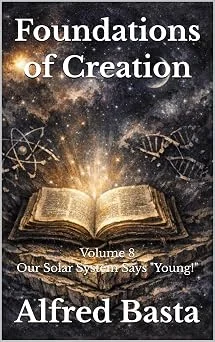
An Encyclopedia Examining the Scientific Case for Biblical Accuracy: Volume 8: Our Solar System Says "Young!"
From Mercury’s surprisingly strong magnetic field to the geysers of Enceladus, from Saturn’s suspiciously fresh rings to the slowly retreating Moon, our solar system is filled with features that simply do not fit a billions-of-years timeline — and in this fascinating volume of Foundations of Creation, young readers get to discover them all. Planet by planet and moon by moon, the evidence accumulates: Jupiter, Saturn, and Neptune radiate far more heat than they should after billions of years; Io’s relentless volcanic activity defies ancient-age models; Europa’s smooth, young-looking surface raises hard questions; and comets that should have burned out long ago are still streaking through the sky. One of the most compelling stories in this volume is that of creation scientist Russell Humphreys, who used a young-universe model to predict the magnetic field strengths of Uranus and Neptune before the Voyager spacecraft arrived — and was proven right while secular scientists were proven wrong. This book is honest about arguments that have not held up as well, modeling the kind of careful, truthful science that creation researchers are committed to. With planet trading cards, fact files, and Solar System Detective activities, this volume makes the scientific case that our cosmic neighborhood looks far younger than the textbooks claim. The solar system is telling us something. Are we listening?
Volume 8 argues that the solar system holds features that do not fit a billions-of-years timeline. It goes body by body through Mercury’s unexpectedly strong magnetic field, the geysers of Enceladus, Saturn’s fresh-looking rings, the Moon’s slow retreat from Earth, the heat output of Jupiter, Saturn, and Neptune, Io’s volcanic activity, Europa’s smooth young-looking surface, and comets that should have burned out long ago. The central story is creation scientist Russell Humphreys, who used a young-universe model to predict the magnetic field strengths of Uranus and Neptune before Voyager arrived, and the book presents the Voyager results as confirming those predictions. The description says the book also acknowledges arguments that have not held up as well. It includes planet trading cards, fact files, and Solar System Detective activities.
It was written by Alfred Basta, a professor, author, and musician.
It is Christian apologetics written as an encyclopedia volume on astronomy, which means it surveys the planets and moons one at a time and adds activities and fact files for young readers.
It is written for young readers, with trading cards and detective activities that make it suitable for families and homeschool use.
Yes. It is Volume 8 of Foundations of Creation: An Encyclopedia Examining the Scientific Case for Biblical Accuracy, a 25-volume series. See the series on Amazon.
Foundations of Creation Volume 8 is available in hardcover and Kindle editions. The hardcover ISBN-13 is 979-8196583773 (277 pages, published May 12, 2026).
Amazon (hardcover) | Amazon (Kindle) | Indigo (author page)
Foundations of Creation: Volume 8 covers the planets, moons, and comets of the solar system and the features the book says do not fit a billions-of-years timeline. Topics include Mercury’s strong magnetic field, the geysers of Enceladus, Saturn’s fresh-looking rings, the slowly retreating Moon, the excess heat of Jupiter, Saturn, and Neptune, Io’s volcanoes, Europa’s smooth surface, and comets that should have burned out. It also tells the story of Russell Humphreys and his magnetic field predictions.
Readers of Foundations of Creation: Volume 8 will learn why the book concludes that the solar system looks far younger than textbooks claim. They will see how creation scientist Russell Humphreys used a young-universe model to predict the magnetic field strengths of Uranus and Neptune before Voyager arrived, and how those predictions held while secular expectations did not. Readers will also learn which arguments have not held up as well, modeling honest and careful science.
Foundations of Creation: Volume 8 stands apart because it examines the solar system from a young-universe perspective and is open about which creationist arguments have held up and which have not. Rather than a simple tour of the planets, it treats each body as a piece of evidence and builds a case planet by planet. The volume also includes planet trading cards, fact files, and Solar System Detective activities that turn reading into investigation for young readers.
Foundations of Creation: Volume 8 suits homeschool families and anyone teaching young readers about the solar system from a biblical viewpoint. The book moves body by body through the planets and moons, so it can be read in short sections, and its planet trading cards, fact files, and Solar System Detective activities give children something to do with what they learn. Its honesty about weaker arguments also gives parents a chance to model careful, truthful science.
About the author: Alfred Basta is a professor, author of Ward No. 8 and The Malgrave Letters, and musician as The Bastas Project.
Last updated: October 23, 2026