Christian
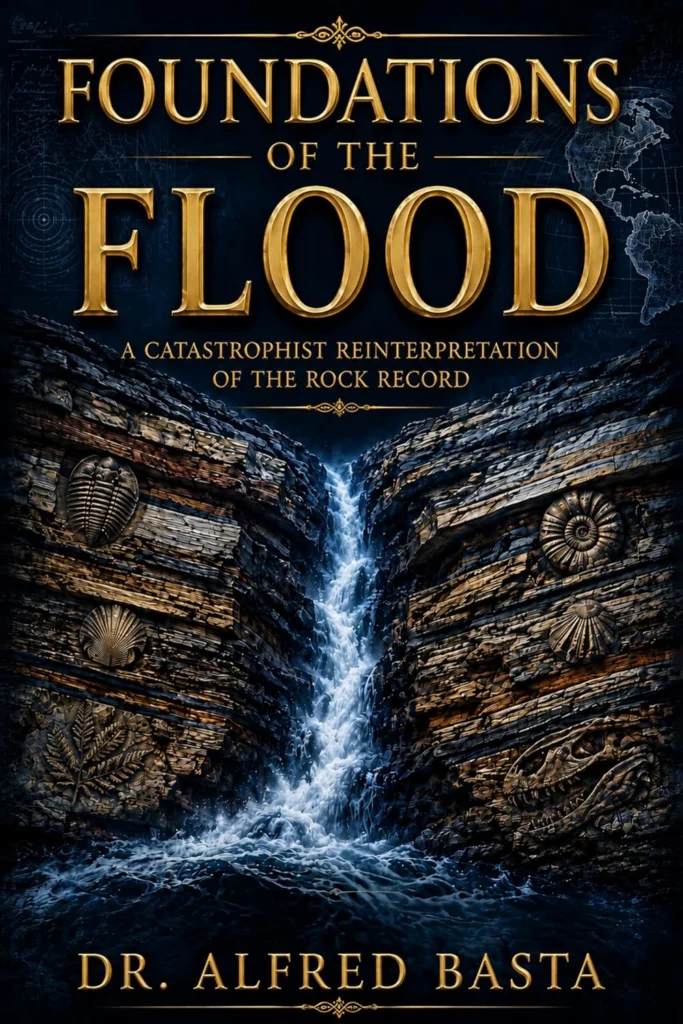
Creation for Adults - Encyclopaedia Book 9
What if the geological record tells a different story than the one most people have been taught?
In Foundations of the Flood, Dr. Alfred Basta challenges conventional interpretations of Earth’s history by presenting a comprehensive catastrophist analysis of the geological record through the lens of the biblical Flood.
Drawing from geology, sedimentology, paleontology, tectonics, and the history of science, this thought-provoking work examines continent-wide sedimentary formations, polystrate fossils, rapid rock deposition, soft-sediment deformation, fossil graveyards, megasequences, erosion rates, coal formation, cave development, and catastrophic plate tectonics. The book argues that many of these geological features are more consistent with rapid, large-scale catastrophic processes than with slow, gradual uniformitarian models.
Readers will also explore the historical development of modern geology, the influence of Charles Lyell’s uniformitarianism, the rise of neocatastrophism, and how contemporary geological discoveries are interpreted within both secular and biblical frameworks.
Whether you are a student of geology, a Christian interested in creation apologetics, a pastor, researcher, or someone seeking to explore alternative interpretations of Earth’s history, Foundations of the Flood provides an extensively researched and intellectually engaging examination of one of science’s most enduring debates.
Ideal for readers interested in:
Foundations of the Flood argues that many geological features are better explained by rapid, large-scale catastrophic processes than by slow, gradual uniformitarian models, and it reads the rock record through the lens of the biblical Flood. It covers continent-wide sedimentary formations, polystrate fossils, rapid rock deposition and soft-sediment deformation, fossil graveyards and megasequences, erosion rates, coal formation, cave development, and catastrophic plate tectonics. It also traces the development of modern geology, Charles Lyell’s uniformitarianism, and the rise of neocatastrophism, showing how new discoveries are interpreted within both secular and biblical frameworks. Drawing on geology, sedimentology, paleontology, tectonics, and the history of science, the book presents catastrophism versus uniformitarianism as a question of how the same evidence is read under different worldviews.
It was written by Alfred Basta, a professor, author, and musician.
It is a technical creation science reference in Flood geology, which means it treats sedimentology, tectonics, and paleontology in depth from a young-earth perspective rather than as a devotional or popular introduction.
It is written for students of geology, Christians interested in creation apologetics, pastors and researchers, and readers exploring alternative interpretations of Earth’s history.
Yes. It is Book 9 of Creation for Adults, Encyclopaedia, a series of technical young-earth creation volumes. You can find the series on Amazon.
Foundations of the Flood is available in paperback, hardcover and Kindle editions. The hardcover ISBN-13 is 979-8187150779 (337 pages, published July 13, 2026).
Amazon (paperback) | Amazon (hardcover) | Amazon (Kindle) | Indigo (author page)
Foundations of the Flood covers the geological record as read through the biblical Flood. Topics include continent-wide sedimentary formations, polystrate fossils, rapid rock deposition, soft-sediment deformation, fossil graveyards, megasequences, erosion rates, coal formation, cave development, and catastrophic plate tectonics. The book also traces the historical development of modern geology, the influence of Charles Lyell’s uniformitarianism, and the rise of neocatastrophism, and it shows how contemporary geological discoveries are interpreted within both secular and biblical frameworks.
Readers of Foundations of the Flood will learn why the author argues that many geological features are more consistent with rapid, large-scale catastrophic processes than with slow uniformitarian models. They will see how polystrate fossils, fossil graveyards, megasequences, and soft-sediment deformation are explained by a catastrophist reading, how coal and caves can form quickly, and what catastrophic plate tectonics proposes. Readers also learn how uniformitarianism came to dominate geology and how neocatastrophism has reopened the debate over Earth’s history.
Foundations of the Flood stands apart by combining a wide technical survey with the history and philosophy of science. It draws on geology, sedimentology, paleontology, and tectonics to examine specific features of the rock record, and it also explains how Charles Lyell’s uniformitarianism shaped modern geology and how neocatastrophism has challenged it. By showing how the same discoveries are read within secular and biblical frameworks, the book presents Flood geology as a question of interpretation and worldview rather than a simple dispute over facts.
Foundations of the Flood is written with students of geology among its intended readers, alongside Christians interested in creation apologetics, pastors, and researchers. A geology student will encounter familiar topics such as sedimentary formations, erosion rates, coal formation, cave development, and plate tectonics, examined from a catastrophist viewpoint. The book’s treatment of Lyell, uniformitarianism, and neocatastrophism also gives students historical context for the assumptions behind conventional geology, making it a useful counterpoint to standard coursework.
About the author: Alfred Basta is a professor, author of Ward No. 8 and The Malgrave Letters, and musician as The Bastas Project.
Last updated: October 23, 2026