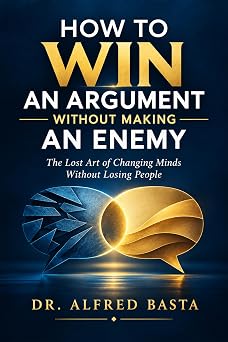
How to Win an Argument Without Making an Enemy: The Lost Art of Changing Minds Without Losing People
What if winning an argument didn't mean having the last word?
What if the real victory was changing someone's mind while still having them want you in their life afterward?
Read the Full Overview
On a Tuesday night at a small restaurant, Dr. Alfred Basta watched two brothers argue about a house, and about their mother, and about something neither of them named. The older brother won on the facts, laid out in a folder. The younger brother said “okay,” put money on the table, and left — and the two men, Basta later learned, never really spoke again. That is the cost this book is written to prevent.
How to Win an Argument Without Making an Enemy redefines what winning a disagreement actually means: not making someone stop talking, but changing their actual mind while they still want you in their life afterward. Across 33 chapters organized into six parts — The Game Nobody Wins, The Person in Front of You, The Mirror, The Tools, Hard Rooms, and After the Argument — Basta draws on nearly three decades spent on tenure committees, faculty senates, and review boards to examine why the loudest, most factually correct person in the room is so often the one who loses what matters.
The book introduces a working vocabulary for disagreement — the Heat Scale, the Argument Under the Argument, the Dignity Rule, the Third Chair — built through scene-based illustrations: a nurse talking down a frightened father in an emergency room, a manager confronting an employee over falsified expense reports, a family absorbing an old wound at a holiday table. Basta argues that real persuasion requires giving up the pleasure of the decisive final point in exchange for something rarer: being trusted with the truth the next time it matters.
Written for spouses, colleagues, and fellow citizens rather than debaters, How to Win an Argument Without Making an Enemy is a practical, narrative-driven case for changing minds without losing people.
What is How to Win an Argument Without Making an Enemy about?
The book is Dr. Alfred Basta’s nonfiction guide to changing people’s minds in real disagreements — at home, at work, and in civic life — without destroying the relationship in the process. Drawing on nearly three decades of experience on tenure committees, faculty senates, and review boards, Basta redefines “winning” an argument and organizes the book into 33 chapters across six parts.
Who is Dr. Alfred Basta?
Dr. Alfred Basta is a professor of Cybersecurity, Computer Science, Information Technology, and Mathematics who holds a Ph.D. in Cryptography and a master’s degree in Computer Science. His author biography describes him as the author of more than a dozen technical textbooks published by Wiley and Cengage, holder of more than sixty professional certifications, and a writer of fiction and narrative nonfiction. He lives in Atlanta, Georgia.
How does the book define “winning” an argument?
Basta argues that a person has won an argument only when two things are both true: the other person has genuinely changed their view of what is true, not merely their tone or volume, and they still want the arguer in their life afterward. The book explicitly excludes humiliating an opponent or simply out-talking them as forms of winning.
What is the “Heat Scale” in the book?
The Heat Scale is a concept the book introduces, illustrated through a scene of an emergency-department nurse de-escalating a frightened, angry parent. Basta uses it to describe how the emotional temperature of a disagreement can be recognized and lowered before persuasion becomes possible.
What is the “Dignity Rule”?
The Dignity Rule is illustrated in the book through a workplace scene involving a manager confronting an employee about falsified expense reports. Basta argues that confronting someone’s wrongdoing without stripping them of their basic dignity as a person makes honest resolution more likely, not less.
What is the “Third Chair” in the book’s conclusion?
The Third Chair is the book’s closing image, drawn from the author’s memory of an uncle who rarely spoke in arguments but was trusted by everyone in the room. Basta argues that in any disagreement there are usually two positions people feel forced to choose between, but a third position exists: caring more about what is true than about who is right.
What do the six parts of the book cover?
Part One (The Game Nobody Wins) examines why winning an argument by beating someone often costs more than it gains. Part Two (The Person in Front of You) covers listening and understanding the other side’s real position. Part Three (The Mirror) turns to the reader’s own anger, pride, and contempt. Part Four (The Tools) presents practical techniques such as conceding early and lowering the stakes. Part Five (Hard Rooms) addresses difficult contexts such as marriage, power imbalances, and bad-faith arguments. Part Six (After the Argument) covers repairing relationships, forgiveness, and trust once a disagreement has ended.
Does the book address arguments with family or a spouse?
Yes. Part Five includes a chapter titled “Marriage Is Not a Debate Club” and another on “The People You Can’t Leave,” addressing how the book’s approach to persuasion applies differently in relationships the reader cannot simply walk away from.
Does the book address workplace or power-imbalanced arguments?
Yes. Part Five includes a chapter on “The Rooms of Unequal Power,” and the book uses at least one illustrative workplace scene — a manager confronting an employee over falsified expense reports — to examine how persuasion and dignity operate when one party holds formal authority over the other.
What does the book mean by “bad faith” arguments?
Chapter 28, “Bad Faith: When You Are Not Actually in an Argument,” addresses situations the book identifies as not being genuine disagreements at all — cases where one party is not actually open to changing their mind — and discusses how to recognize this.
What is the book’s approach to being wrong or apologizing?
Chapter 23, “How to Say You Were Wrong,” and Chapter 30, “How to Forgive Someone Who Isn’t Sorry,” address the book’s view that admitting error and offering or receiving forgiveness are skills that determine whether a relationship survives a disagreement, not signs of weakness.
What kind of evidence or illustrations does the book use?
The author presents scene-based illustrations — such as two brothers arguing over a house after their mother’s death, an emergency-room de-escalation, and a workplace confrontation over expense fraud — that he frames as narrative-nonfiction illustrations drawn from decades of observing disagreement, rather than as verbatim transcripts or documented, independently verified case studies.
Who is the book for?
The book is positioned for people who want to change others’ minds in real relationships that matter to them — spouses, family members, colleagues, and fellow citizens — rather than for readers seeking rhetorical tactics to win debates or arguments for their own sake.
What are Appendix A and Appendix B?
Appendix A, “The Field Manual,” and Appendix B, “The Thirty-Day Program,” are presented as practical, applied companions intended to help readers put the book’s approach into practice.
How does this book relate to How to Run the Room Without Saying a Word?
Both are nonfiction narrative works by Dr. Alfred Basta exploring interpersonal power and influence, drawing on his decades observing institutional life. How to Run the Room Without Saying a Word focuses on earning durable authority in rooms and organizations, while How to Win an Argument Without Making an Enemy focuses specifically on changing minds in direct disagreement without damaging the relationship. The manuscript does not present them as a single named series.
What is How to Win an Argument Without Making an Enemy about?
How to Win an Argument Without Making an Enemy redefines what winning means: not making someone stop talking, but changing their actual mind while they still want you in their life afterward. Its thirty-three chapters, organized in six parts, cover listening, self-examination, practical tools, difficult contexts such as marriage and workplace power imbalances, and repairing relationships after the argument is over. The illustrations are scene-based rather than verbatim transcripts, drawn from nearly three decades on tenure committees, faculty senates, and review boards.
Who wrote How to Win an Argument Without Making an Enemy?
It was written by Alfred Basta, a professor, author, and musician, drawing on nearly three decades of committee rooms, faculty senates, and review boards where disagreements had to be settled without ending working relationships.
What genre is How to Win an Argument Without Making an Enemy?
It is practical nonfiction on communication and relationships. It is written for everyday disagreements rather than formal debate.
Who is How to Win an Argument Without Making an Enemy for?
It is for spouses, colleagues, and fellow citizens rather than debaters: anyone who has to disagree with people they cannot afford to lose.
Is How to Win an Argument Without Making an Enemy part of a series?
No. How to Win an Argument Without Making an Enemy is a standalone book. A natural companion is How to Become the Most Trusted Person.
Where can I buy How to Win an Argument Without Making an Enemy?
The book is available in paperback, hardcover, and Kindle editions. The paperback ISBN-13 is 979-8174243132 (333 pages, published September 14, 2026).
Amazon (paperback) | Amazon (Kindle) | Indigo (author page) | Goodreads
About the author: Alfred Basta is a professor, author of Ward No. 8 and The Malgrave Letters, and musician as The Bastas Project.
Last updated: October 12, 2026