Academic
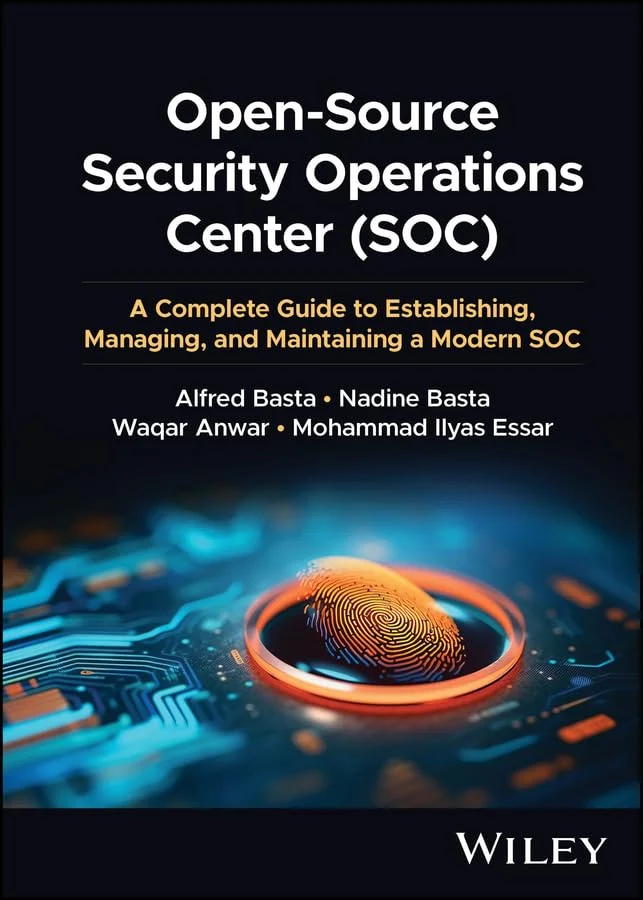
A comprehensive and up-to-date exploration of implementing and managing a security operations center in an open-source environment
In Open-Source Security Operations Center (SOC): A Complete Guide to Establishing, Managing, and Maintaining a Modern SOC, a team of veteran cybersecurity practitioners delivers a practical and hands-on discussion of how to set up and operate a security operations center (SOC) in a way that integrates and optimizes existing security procedures. You’ll explore how to implement and manage every relevant aspect of cybersecurity, from foundational infrastructure to consumer access points.
In the book, the authors explain why industry standards have become necessary and how they have evolved – and will evolve – to support the growing cybersecurity demands in this space. Readers will also find:
Perfect for cybersecurity practitioners and software engineers working in the industry, Open-Source Security Operations Center (SOC) will also prove invaluable to managers, executives, and directors who seek a better technical understanding of how to secure their networks and products.
Open-Source Security Operations Center (SOC) is a hands-on guide to setting up and running a security operations center using open-source tools, with an emphasis on integrating them with the security procedures an organization already has. It covers securing everything from core infrastructure to end-user access points, explains how industry standards arose and how they are expected to change, and gives detailed coverage of tools for prevention and detection such as vulnerability assessment, behavioral monitoring, and asset discovery. The structure is modular for classroom use, with hands-on exercises, case studies, and end-of-chapter questions.
It was written by Alfred Basta, a professor, author, and musician, with co-authors Nadine Basta, Waqar Anwar, and Mohammad Ilyas Essar, a team of veteran cybersecurity practitioners. It was published by Wiley in 2024.
It is a cybersecurity textbook and practitioner guide on security operations, built for both the classroom and the working SOC.
It is for cybersecurity practitioners, software engineers, and managers or executives who want a clearer technical understanding of how to secure their networks and products, as well as students in security operations courses.
No. Open-Source Security Operations Center (SOC) is a standalone Wiley textbook. A companion title from the same authors is Pen Testing from Contract to Report.
The book is available in hardcover and Kindle editions from Amazon and directly from Wiley. The hardcover ISBN-13 is 978-1394201600 (480 pages, published October 8, 2024).
Amazon (hardcover) | Amazon (Kindle) | Barnes & Noble | Bookshop | Indigo (author page) | Wiley
Open-Source Security Operations Center (SOC) covers how to set up and operate a security operations center in a way that integrates and optimizes an organization’s existing security procedures. It addresses every relevant aspect of cybersecurity from foundational infrastructure to consumer access points. The book explains why industry standards became necessary and how they have evolved and will keep evolving, and it discusses SOC tools for threat prevention and detection, including vulnerability assessment, behavioral monitoring, and asset discovery.
Readers of Open-Source Security Operations Center (SOC) will learn how to establish, manage, and maintain a modern SOC using a practical, hands-on method. They will understand how to implement security across infrastructure and access points, how to use tools for vulnerability assessment, behavioral monitoring, and asset discovery, and how industry standards shape the work. Hands-on exercises, case studies, and end-of-chapter questions are included to support learning and retention.
Open-Source Security Operations Center (SOC) uses a modular design so that it can be used in a variety of classrooms and instructional settings. Each module presents a part of SOC implementation and management, from infrastructure through detection tools and standards, and chapters are supported by hands-on exercises, case studies, and end-of-chapter questions. The modular structure also lets working practitioners go directly to the areas they need.
Open-Source Security Operations Center (SOC) is written for cybersecurity practitioners and software engineers, but its authors also intend it for managers, executives, and directors who want a better technical understanding of how to secure their networks and products. A leader can use it to grasp what a SOC does, which tools it relies on for prevention and detection, and why industry standards matter, without having to run the operations personally.
About the author: Alfred Basta is a professor, author of Ward No. 8 and The Malgrave Letters, and musician as The Bastas Project.
Last updated: October 23, 2026