
Christian
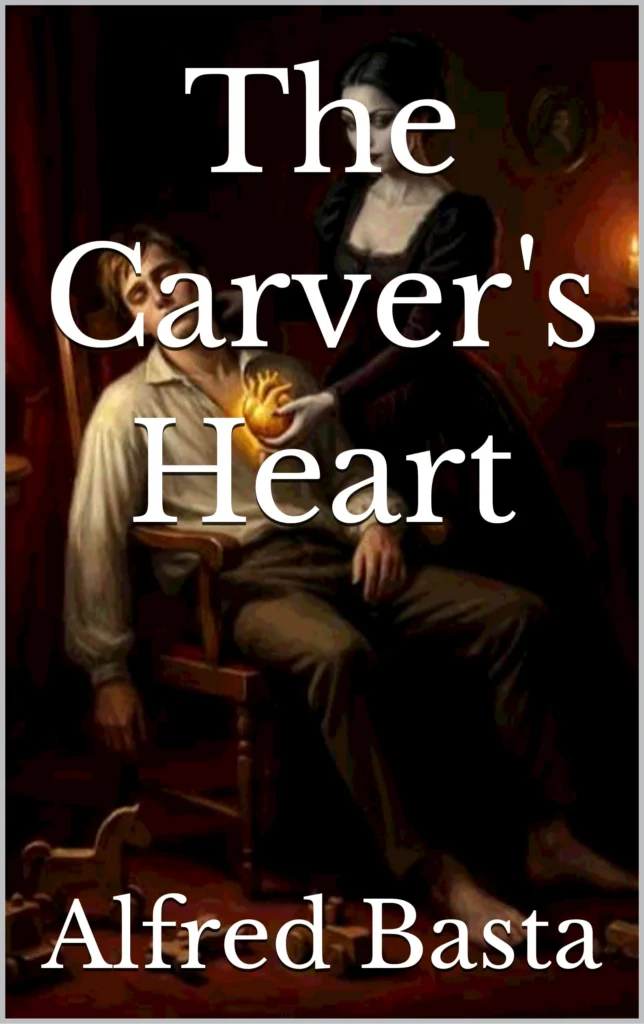
Born with nothing but a knife, a block of wood, and the open road, a young craftsman wanders from town to town, trading handmade wooden toys for coins enough to survive another day. He asks for little. He expects less. And the world, in its infinite cruelty, gives him exactly that.
The Carver’s Heart follows a young wood carver who travels from town to town with only a knife and a block of wood, trading handmade wooden toys for enough to get by and expecting little from life. On a stormy night, exhausted and hungry, he reaches a village where a striking woman takes him in and offers food, shelter, and kindness. He never wakes from the sleep that follows. The woman is not what she seems, and the villagers knew what was happening: they watched, whispered, and wept. The novel explores deprivation, deception, the gap between appearance and reality, and the silence of a community that knows the truth and does nothing. The paperback runs 431 pages.
It was written by Alfred Basta, a professor, author, and musician.
It is a work of fiction with the feel of a dark fable, which means it uses a simple, archetypal setup, a traveler, a stranger, and a village, to explore darker questions about kindness, deception, and complicity.
The description does not name a specific audience. Its tone suits readers who enjoy dark, fable-like fiction with a sinister undercurrent.
No. The Carver’s Heart is a standalone book.
The Carver’s Heart is available in paperback and Kindle editions. The paperback ISBN-13 is 979-8254244127 (492 pages, published March 30, 2026).
Amazon (paperback) | Amazon (Kindle) | Indigo (author page)
The Carver’s Heart follows a young craftsman who owns nothing but a knife, a block of wood, and the open road. He drifts from town to town trading handmade wooden toys for coins enough to survive, asking little of the world and receiving less. On a stormy night, soaked and starving, he reaches a village where a hauntingly beautiful woman offers him warmth, food, shelter, and kindness. He never wakes from the sleep that follows, and the villagers knew.
The Carver’s Heart confronts the gap between appearance and reality and the cost of a community’s silence. The woman who takes the carver in is not what she appears, and the villagers who watched, whispered, and wept did nothing to warn him. The novel asks what kindness is worth when it is a disguise, and what guilt belongs to those who know the truth and keep quiet. It is a dark fable about deprivation, deception, and complicity.
Alfred Basta writes The Carver’s Heart as a dark fable built on an archetypal setup: a wandering traveler, a mysterious stranger, and a village with a secret. The spare, deliberate telling of the carver’s hard life and the single night of kindness that ends it gives the story a sinister undercurrent. By having the villagers know and stay silent, he widens the tale from one deception to a question about collective complicity.
The Carver’s Heart is well matched to readers who like fable-like fiction with a sinister edge. It uses the simple elements of a folk tale, a poor wanderer, a stranger’s hospitality, and a watching village, and turns them toward darker questions about deception and complicity. Readers who prefer uplifting stories may find it unsettling, but those drawn to shadowed, archetypal storytelling will find the book’s tone suited to them.
About the author: Alfred Basta is a professor, author of Ward No. 8 and The Malgrave Letters, and musician as The Bastas Project.
Last updated: October 23, 2026