Apologetics
Creation for Adults - Encyclopaedia Book 25
What happens when the claims of modern science, evolutionary theory, and biblical creationism collide?
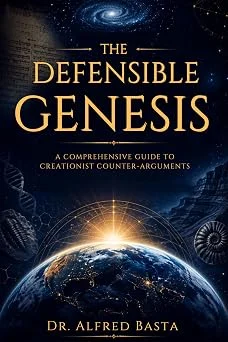
The Defensible Genesis: A Comprehensive Guide to Creationist Counter-Arguments offers a wide-ranging young-earth creationist response to some of the most common objections raised against the biblical account of creation. Written as an accessible reference and roadmap, this volume examines questions about the origin of the universe, the age of the earth, biological complexity, fossils, evolution, Genesis, and the relationship between faith and science.
Beginning with the foundations of science and worldview, Dr. Alfred Basta explores the distinction between operational science and historical science and challenges the assumption that scientific methodology necessarily requires philosophical naturalism. The book examines the relationship between scientific inquiry and biblical revelation, arguing that questions about origins cannot be separated from the worldview used to interpret the evidence.
The discussion then moves into major scientific and historical challenges to young-earth creationism, including:
A central theme throughout the book is that the same physical evidence can be interpreted through fundamentally different philosophical and historical frameworks. Rather than treating the creation-evolution debate as merely a conflict between “science” and “faith,” the book presents it as a deeper debate over competing worldviews, assumptions about the past, and the authority of Scripture.
Designed as a single-volume reference and starting point, The Defensible Genesis also provides cross-references to other volumes in the series for readers who want more detailed treatment of particular subjects.
For readers seeking a sustained defense of biblical creationism, this book brings together scientific arguments, philosophical analysis, historical discussion, and theological reasoning in one comprehensive volume.
The Defensible Genesis is a young-earth creationist response to common objections to the biblical creation account. It opens with the foundations of science and worldview, distinguishing operational science from historical science and arguing that the scientific method does not require philosophical naturalism. It then works through specific challenges: distant starlight and young-earth cosmological models such as gravitational time dilation and the Anisotropic Synchrony Convention; radiometric dating, ice cores, varves, and tree rings; transitional fossils, the Cambrian Explosion, biological complexity, and vestigial organs; the Genesis Flood; and the historical Adam, the Fall, and death before humanity. It also engages Intelligent Design, progressive creationism, theistic evolution, and old-earth views associated with Hugh Ross, John Lennox, and BioLogos, and closes with the history of the young-earth movement. The book is designed as a single-volume reference with cross-references to other volumes in the series.
It was written by Alfred Basta, a professor, author, and musician.
It is Christian apologetics in the form of a creation science reference, which means it is organized around objections and answers and can be used as a starting point or lookup volume rather than read only front to back.
It is for readers who want a sustained defense of biblical creationism with scientific, philosophical, historical, and theological arguments combined in one volume.
Yes. It is Book 25 of Creation for Adults, Encyclopaedia, and it cross-references other volumes in the series. You can find the series on Amazon.
The Defensible Genesis is available in paperback, hardcover and Kindle editions. The paperback ISBN-13 is 979-8172533570 (354 pages, published September 7, 2026).
Amazon (paperback) | Amazon (hardcover) | Amazon (Kindle) | Indigo (author page)
The Defensible Genesis covers the most common objections raised against the biblical account of creation and offers young-earth creationist responses to each. Topics include operational versus historical science, the distant starlight problem and young-earth cosmological models, gravitational time dilation and the Anisotropic Synchrony Convention, radiometric dating, ice cores, varves, tree rings, transitional fossils, the Cambrian Explosion, biological complexity and vestigial organs, the Genesis Flood, the historical Adam and the Fall, Intelligent Design, progressive creationism, theistic evolution, and the history of the young-earth movement.
Readers of The Defensible Genesis will learn that the same physical evidence can be interpreted through fundamentally different philosophical and historical frameworks. The book teaches readers to see the creation-evolution debate as a conflict over worldviews, assumptions about the past, and the authority of Scripture rather than a simple clash between science and faith. Readers also gain a working knowledge of the main scientific challenges to young-earth creationism and the responses to arguments associated with Hugh Ross, John Lennox, and BioLogos.
The Defensible Genesis is organized as an accessible reference and roadmap. It begins with the foundations of science and worldview, including the distinction between operational science and historical science and the question of whether scientific method requires philosophical naturalism. It then moves through the major scientific, historical, and theological challenges to young-earth creationism one by one, and closes with the history and current development of the global young-earth movement. Cross-references point readers to other volumes for more detailed treatment.
The Defensible Genesis answers questions such as how light from distant stars can reach a young earth, what assumptions underlie radiometric dating and deep-time chronologies, whether ice cores, varves, and tree rings prove immense ages, what the Cambrian Explosion and transitional fossils show, whether so-called vestigial organs undermine design, how the Genesis Flood shaped geology, whether Adam was a real historical person, and how biblical creationism relates to Intelligent Design, progressive creationism, and theistic evolution.
About the author: Alfred Basta is a professor, author of Ward No. 8 and The Malgrave Letters, and musician as The Bastas Project.
Last updated: October 23, 2026