Christian
Can the ancient truths of the Christian faith survive the frontiers of the future?
In the United States of 2047, public discourse on empirical inquiry is strictly governed by the Standards Reaffirmation Act. Section $17(c)$ enforces a rigid boundary: no theological contamination may enter the discussion of frontier science. The enforcement is ruthless, led by a powerful, private legal foundation known as the Athenaeum.
Christian Cross, a fifty-four-year-old professor of apologetics at Logos University in eastern Tennessee, is no stranger to this battle. He has been tried thirteen times prior on the foundations of belief, doctrine, and truth—and each verdict has been a defense acquittal.
Now, the fourteenth and final indictment has arrived. The domain is the future.
The government charges that Cross’s teachings have contaminated the public understanding of artificial intelligence, transhumanism, gene editing, astrobiology, and the simulation hypothesis by introducing theological categories like the imago Dei, the Logos, and bodily resurrection. Led by the brilliant and formidable prosecutor Charles Frey, the state seeks to silence theological reasoning for good.
Supported by an unlikely alliance—including Dr. Imogen Tarrant, a recently converted Cambridge AI safety researcher; Sister Cassandra Lyle, a Dominican philosopher; and Father Demetrios Stavros, a Greek Orthodox priest—Cross must step into a Knoxville federal courtroom for a three-week televised trial that will decide what kind of public reason the Republic will keep, and what it will let go.
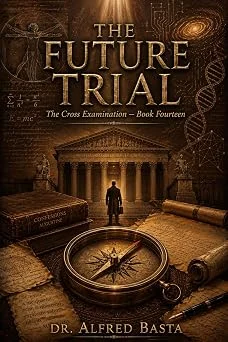
Written to stand alone, The Future Trial is a gripping, intellectually profound courtroom drama that confronts the ultimate question: What makes a person?
The Future Trial is set in the United States in 2047, where the Standards Reaffirmation Act forbids any theological contamination of frontier science and a private legal foundation called the Athenaeum enforces the rule. Christian Cross, a 54-year-old professor of apologetics in eastern Tennessee, has already won thirteen trials on belief, doctrine, and truth. The fourteenth indictment charges that his teaching has contaminated public understanding of artificial intelligence, transhumanism, gene editing, astrobiology, and the simulation hypothesis with concepts such as the imago Dei, the Logos, and bodily resurrection. Prosecutor Charles Frey leads the state’s effort to silence theological reasoning for good, while Cross is joined by Imogen Tarrant, a recently converted AI safety researcher, Sister Cassandra Lyle, a Dominican philosopher, and Father Demetrios Stavros, a Greek Orthodox priest. The three-week televised federal trial in Knoxville will decide what kind of public reason the Republic keeps, and at its center is the question of what makes a person.
It was written by Alfred Basta, a professor, author, and musician.
It is Christian fiction in the form of a speculative courtroom drama, which means the arguments about faith, technology, and personhood unfold through testimony and cross-examination in a near-future setting.
It is for readers of Christian fiction who enjoy intellectual, speculative, and courtroom drama, and for anyone drawn to apologetics and debates about technology, AI, and human nature.
Yes. It is Book 14 of The Cross Examination, the fourteenth and final indictment in the series, following The Shepherd Trial (Book 13) and The Creed Trial (Book 12). The description says it is written to stand alone, so new readers can start here. You can find the series on Amazon.
The Future Trial is available in paperback, hardcover and Kindle editions. The hardcover ISBN-13 is 979-8183612332 (305 pages, published June 21, 2026).
Amazon (paperback) | Amazon (hardcover) | Amazon (Kindle) | Indigo (author page)
In The Future Trial, set in the United States of 2047, Christian Cross faces his fourteenth and final indictment under the Standards Reaffirmation Act, which bars theological ideas from discussions of frontier science. The government, backed by the Athenaeum legal foundation and led by prosecutor Charles Frey, charges that his teaching has contaminated public understanding of artificial intelligence, transhumanism, gene editing, astrobiology, and the simulation hypothesis. Joined by Imogen Tarrant, Sister Cassandra Lyle, and Father Demetrios Stavros, Cross defends himself in a three-week televised trial in Knoxville.
The main message of The Future Trial is that theological categories such as the imago Dei, the Logos, and bodily resurrection belong in public reasoning about humanity’s future, not outside it. By placing artificial intelligence, transhumanism, gene editing, astrobiology, and the simulation hypothesis on trial alongside Christian teaching, the novel argues that the question of what makes a person cannot be settled by science alone. It also asks what kind of public reason a free society should keep and what it should be willing to lose.
Alfred Basta tells The Future Trial as a courtroom drama, letting the arguments about faith and technology unfold through indictment, testimony, and cross-examination rather than essay. He sets the story in a near-future America governed by the Standards Reaffirmation Act and gives Christian Cross an unlikely team of allies, including a converted AI safety researcher, a Dominican philosopher, and a Greek Orthodox priest, so that different voices carry the defense. The book is written to stand alone, so readers can follow it without the earlier trials.
The Future Trial is a strong fit for readers who want to think about artificial intelligence, transhumanism, and gene editing from a Christian perspective. The trial itself centers on whether theological concepts may inform public discussion of these frontier sciences, and one of Cross’s allies is an AI safety researcher who has recently come to faith. Readers who enjoy intellectually demanding fiction, legal suspense, and apologetics will find the three-week televised trial a natural way to engage the question of what makes a person.
About the author: Alfred Basta is a professor, author of Ward No. 8 and The Malgrave Letters, and musician as The Bastas Project.
Last updated: October 23, 2026