Academic
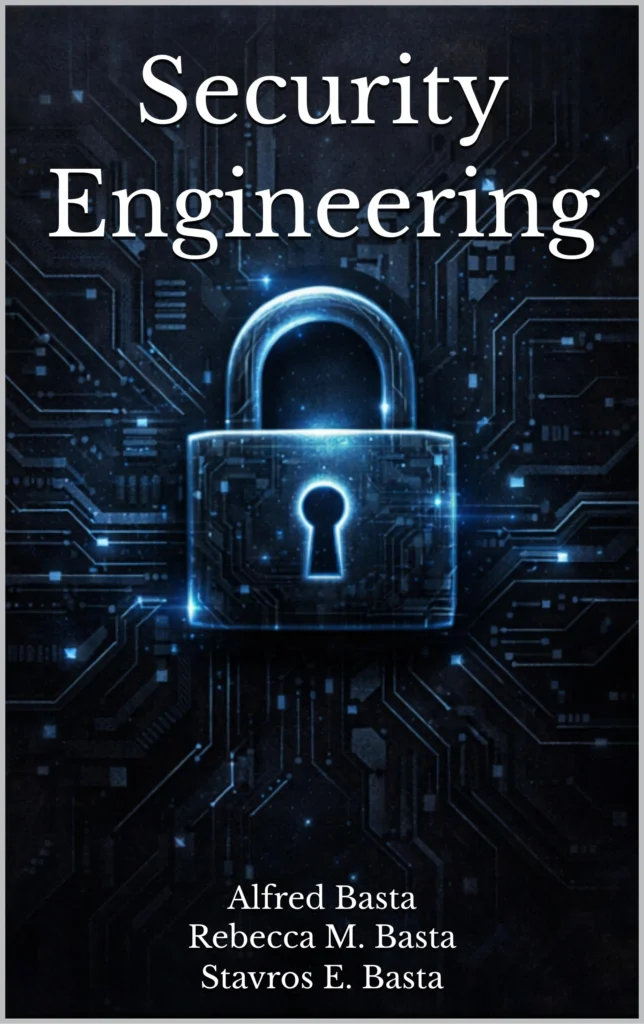
In a world where digital threats evolve faster than the systems designed to stop them, security can no longer be an afterthought; it must be engineered from the ground up.
Security Engineering argues that security can no longer be an afterthought and must be engineered into systems from the start, because digital threats evolve faster than defenses. It is written as a practitioner-focused guide to building systems that both work and withstand attack. The book covers the changing threat landscape of modern infrastructure, privacy-preserving design, threat and risk evaluation, and building assurance cases to justify security claims. It also teaches adversarial thinking through red teaming and penetration testing, and explains how authentication mechanisms work internally. The hardcover edition runs 569 pages.
It was written by Alfred Basta, a professor, author, and musician, with co-authors Rebecca M. Basta and Stavros E. Basta.
It is a cybersecurity textbook and technical reference, which means it is organized around engineering principles and practices rather than narrative, and is meant to be studied and consulted as a working guide.
It is written for security professionals, architects, and developers who build or evaluate systems and want security designed in from the beginning.
No. Security Engineering is a standalone book. Readers interested in Alfred Basta’s technical work may also look at his other cybersecurity titles.
Security Engineering is available in hardcover and Kindle editions. The hardcover ISBN-13 is 979-8253861080 (479 pages, published March 27, 2026).
Amazon (hardcover) | Amazon (Kindle) | Indigo (author page)
Security Engineering covers every critical dimension of building systems that are secure by design. Its topics include the shifting threat landscape of modern infrastructure, privacy-preserving design, threat and risk evaluation, the construction of airtight assurance cases, and adversarial thinking through red teaming and penetration testing. The book also dissects the inner workings of authentication mechanisms and access controls so that readers understand not only what to deploy but how it functions.
Readers of Security Engineering will learn to engineer security from the ground up rather than bolting it on afterward. They will master threat and risk evaluation, learn to construct assurance cases that justify security claims, and adopt the mindset of an adversary through red teaming and penetration testing. They will also understand how authentication mechanisms work internally and how privacy-preserving design fits into modern infrastructure, so that the systems they build both function and survive.
Alfred Basta, with co-authors Rebecca M. Basta and Stavros E. Basta, takes a rigorous, practitioner-focused approach in Security Engineering. The book is framed as a journey through the discipline for professionals, architects, and developers, and it begins from the premise that digital threats evolve faster than the systems meant to stop them. Its emphasis falls on engineering practice: evaluating risk, building assurance cases, thinking like an attacker, and understanding mechanisms from the inside.
Security Engineering is written for architects alongside security professionals and developers, and its central argument speaks directly to their role: security must be designed in from the beginning, not added later. An architect gains methods for threat and risk evaluation, a framework for assurance cases, and insight into authentication and access control internals, together with the adversarial perspective of red teaming. The book aims at systems that survive attack, not merely function.
About the author: Alfred Basta is a professor, author of Ward No. 8 and The Malgrave Letters, and musician as The Bastas Project.
Last updated: October 23, 2026