Christian
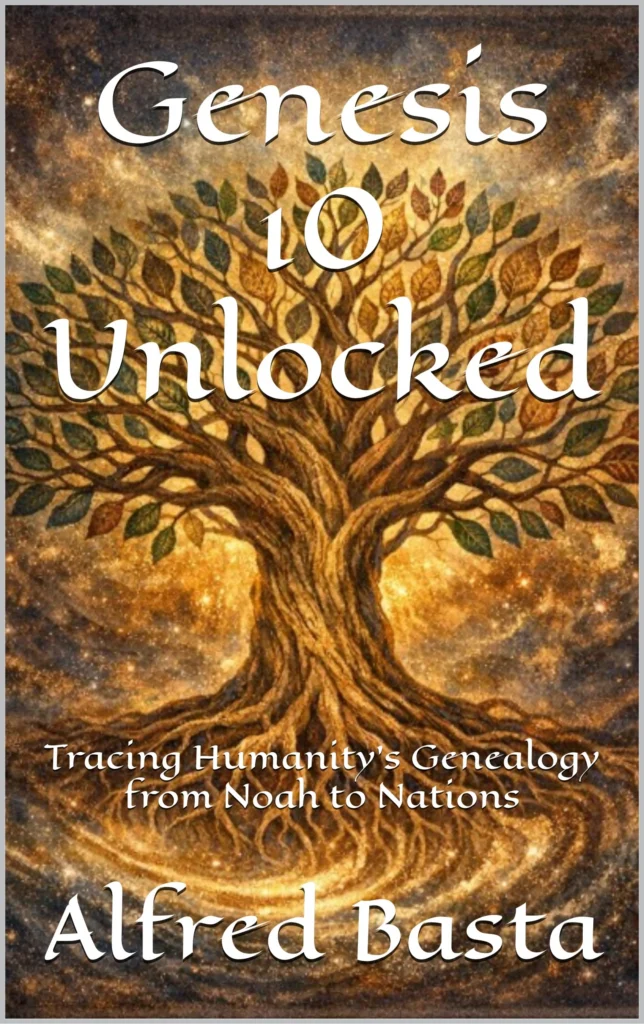
What if the names in Genesis 10 were never meant to be read as a vague list of ancient peoples, but as a carefully preserved historical map of humanity's early divisions?
Genesis 10 Unlocked argues that Genesis 10 may be a carefully preserved historical map of humanity’s early divisions rather than a vague list of ancient peoples. Its central question is whether later tradition blurred the distinction between Joktan’s descendants and the Ishmaelite line. The author draws on biblical genealogy, classical historiography, Arab tradition, archaeology, and textual analysis. The study moves from Noah to Abraham, from Josephus to Islamic historiography, and from the incense kingdoms of southern Arabia to the desert tribes of the north, building a cumulative case for restoring a lost lineage. The description calls the approach rigorous and provocative. The paperback runs 189 pages.
It was written by Alfred Basta, a professor, author, and musician.
It is a work of biblical studies and theology, which means it combines close reading of Scripture with history and archaeology to make an argument about the identity of ancient peoples.
The description does not name a specific audience. It suits readers interested in biblical genealogy, ancient Near Eastern history, and the Table of Nations.
No. Genesis 10 Unlocked is a standalone book. Readers interested in biblical chronology may also look at The Divided Kingdom: A Comprehensive Chronology of Israel and Judah.
Genesis 10 Unlocked is available in paperback and Kindle editions. The paperback ISBN-13 is 979-8255861637 (237 pages, published April 10, 2026).
Amazon (paperback) | Amazon (Kindle) | Indigo (author page)
Genesis 10 Unlocked covers the Table of Nations in Genesis 10 and what it reveals about humanity’s early divisions after Noah. It draws on biblical genealogy, classical historiography, Arab tradition, archaeology and textual analysis, moving from Noah to Abraham, from Josephus to Islamic historiography, and from the incense kingdoms of southern Arabia to the desert tribes of the north. Its central subject is whether later tradition blurred the line between Joktan’s descendants and the Ishmaelites.
Readers of Genesis 10 Unlocked will learn to read one of the Bible’s most overlooked chapters as a carefully preserved historical map rather than a vague list of ancient peoples. They will see how biblical genealogy lines up with classical historians, Arab tradition and archaeology, how Josephus and later Islamic writers handled these names, and why the author believes a lost lineage descending from Joktan can be restored and distinguished from the line of Ishmael.
Alfred Basta treats Genesis 10 as history to be tested rather than a list to be skipped. In Genesis 10 Unlocked he combines biblical genealogy, classical historiography, Arab tradition, archaeology and textual analysis into a single cumulative case, following the names from Noah to Abraham and across the Arabian peninsula from the incense kingdoms of the south to the desert tribes of the north. The description calls the result a rigorous and provocative journey that reexamines a long-standing question.
Genesis 10 Unlocked answers whether the names in Genesis 10 were meant as a historical map of humanity’s early divisions, and whether later tradition blurred the distinction between Joktan’s descendants and the Ishmaelite line. It asks what classical historians, Josephus, Arab tradition and Islamic historiography preserved about these peoples, what archaeology in southern and northern Arabia shows, and how a cumulative case can be built for restoring a lineage the author believes has been lost.
About the author: Alfred Basta is a professor, author of Ward No. 8 and The Malgrave Letters, and musician as The Bastas Project.
Last updated: October 23, 2026