Christian
Creation for Adults - Encyclopaedia Book 10
Can radiometric dating withstand rigorous scientific scrutiny?
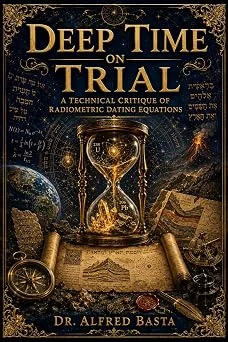
Deep Time on Trial presents a detailed technical critique of the assumptions underlying radiometric dating and conventional geological timescales.
Written by cybersecurity professor, mathematician, and researcher Dr. Alfred Basta, this book examines the scientific, mathematical, and philosophical foundations of modern geochronology from a biblical creation perspective.
Through extensive discussion of potassium-argon, uranium-lead, rubidium-strontium, carbon-14 dating, helium diffusion, radiohalos, and the RATE Project, the book explores the assumptions of initial isotope conditions, closed systems, and constant decay rates. It also analyzes observational anomalies, discordant dating results, and alternative interpretations that support a young-earth framework.
Whether you are a scientist, engineer, theologian, pastor, student, or reader interested in the origins debate, this volume offers a comprehensive examination of one of the most debated topics in earth science.
Inside you’ll discover:
Deep Time on Trial is designed for readers seeking an in-depth exploration of radiometric dating from a creation science perspective while engaging with the technical literature surrounding Earth’s history and geochronology.
Deep Time on Trial examines the scientific, mathematical, and philosophical foundations of modern geochronology from a biblical creation perspective. It evaluates the major radiometric methods, including potassium-argon, uranium-lead, rubidium-strontium, and carbon-14 dating, and challenges the core assumptions behind them: initial isotope conditions, closed systems, and constant decay rates. It discusses carbon-14 in ancient materials, helium diffusion, radiohalos, and the RATE Project, along with discordant dating results and geological anomalies. The book then offers a biblical creationist interpretation of Earth’s history and the scientific and philosophical arguments surrounding deep time. Its central claim is that conventional geological timescales rest on contestable assumptions and that a young-earth reading of the evidence is viable.
It was written by Alfred Basta, a professor, author, and musician.
It is a technical creation science reference, a young-earth critique of radiometric dating, which means it engages the technical literature on isotope systems rather than offering a popular overview.
It is written for scientists, engineers, theologians, pastors, students, and general readers interested in the origins debate who want an in-depth treatment of radiometric dating.
Yes. It is Book 10 of Creation for Adults, Encyclopaedia, a series of technical young-earth creation volumes. You can find the series on Amazon.
Deep Time on Trial is available in paperback, hardcover and Kindle editions. The hardcover ISBN-13 is 979-8187166565 (325 pages, published July 13, 2026).
Amazon (paperback) | Amazon (hardcover) | Amazon (Kindle) | Indigo (author page)
Deep Time on Trial covers the major radiometric dating methods, including potassium-argon, uranium-lead, rubidium-strontium, and carbon-14, along with helium diffusion, radiohalos, and the findings of the RATE Project. It examines the assumptions of initial isotope conditions, closed systems, and constant decay rates on which these methods rest, and it reviews observational anomalies and discordant dating results. The book also discusses carbon-14 in ancient materials, offers a biblical creationist interpretation of Earth’s history, and sets out scientific and philosophical arguments concerning deep time.
Readers of Deep Time on Trial will learn how each major isotope dating system works and what assumptions must hold for its results to be trusted. They will see why initial conditions, closed systems, and constant decay rates are open to question, how discordant dates and geological anomalies arise, and what carbon-14 in ancient materials, helium diffusion, and radiohalos suggest about Earth’s age. Readers also learn how a young-earth framework interprets the same data and how the technical literature can be engaged from a creation perspective.
Alfred Basta takes a technical approach in Deep Time on Trial, bringing his background as a mathematician and researcher to the scientific, mathematical, and philosophical foundations of geochronology. Rather than offering a popular overview, he engages the technical literature on isotope systems, evaluates each method’s limitations, and weighs anomalies and alternative interpretations. The analysis is conducted from a biblical creation perspective, so the book pairs its critique of deep time with a young-earth reading of Earth’s history and the philosophical arguments that support it.
Deep Time on Trial is written with scientists, engineers, theologians, pastors, and students in mind, and its technical depth makes it well suited to readers with a scientific background. Scientists and engineers will find detailed treatment of potassium-argon, uranium-lead, rubidium-strontium, and carbon-14 methods, the mathematics of isotope assumptions, and the evidence from helium diffusion and radiohalos. The book expects readers to follow technical argument and to weigh the radiometric literature critically from a creation science perspective.
About the author: Alfred Basta is a professor, author of Ward No. 8 and The Malgrave Letters, and musician as The Bastas Project.
Last updated: October 23, 2026