Christian
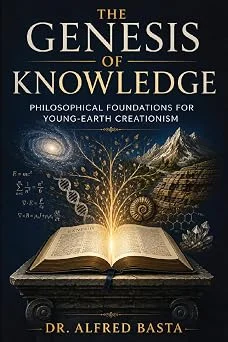
Creation for Adults - Encyclopaedia Book 1
Unlock the unshakeable philosophical and logical foundations of Biblical Creation.
In The Genesis of Knowledge, acclaimed scholar and professor Dr. Alfred Basta delivers a rigorous, monumental defense of young-earth creationism. Moving beyond traditional data-driven debates, Dr. Basta exposes a deeper truth: the conflict over origins is not merely a battle over isolated empirical facts, but a fundamental clash of totalizing worldviews.
Before any fossil is unburied or any rock layer measured, the secular establishment demands absolute epistemic neutrality. Dr. Basta systematically dismantles this “myth of neutrality,” unmasking the hidden metaphysical biases, uniformitarian dogmas, and philosophical naturalism that actively coerce scientific data to fit a predetermined materialistic narrative.
Drawing heavily upon the presuppositional methodology of Cornelius Van Til and Greg Bahnsen, alongside the rigorous deductive logic of classical apologists like R.C. Sproul, this book constructs an impenetrable architectural framework for the Christian mind. Dr. Basta masterfully deploys the Transcendental Argument for God (TAG), proving that the universal, invariant, and immaterial laws of logic, the uniformity of nature, and objective morality are utterly unintelligible apart from the Triune God of Genesis.
Inside this comprehensive volume, you will discover:
Excellence in technical mastery and spiritual depth are not mutually exclusive—they are mutually enriching. The Genesis of Knowledge elevates the creation debate to its highest intellectual plane, showing that the Holy Scriptures stand not as a conclusion reached after a neutral investigation, but as the absolute, indispensable starting point for all true knowledge.
Equip your mind. Defend the truth of Genesis.
The Genesis of Knowledge argues that the origins debate is not just about disputed evidence but a clash of worldviews, and that secular science presents itself as neutral while relying on hidden metaphysical assumptions, uniformitarian premises, and philosophical naturalism. It presents Scripture as the starting point for knowledge, drawing on the presuppositional apologetics of Cornelius Van Til and Greg Bahnsen, the deductive logic of R.C. Sproul, and Thomas Kuhn’s ideas about paradigms. It uses the Transcendental Argument for God, separates repeatable operational science from inferred historical science, catalogs alleged fallacies in evolutionary arguments such as equivocation and circular uniformitarian geology, and examines how established views absorb anomalies. It critiques the day-age theory, the framework hypothesis, theistic evolution, and progressive creationism, and it links Darwinism to Social Darwinism, eugenics, and scientific racism.
It was written by Alfred Basta, a professor, author, and musician.
It is Christian apologetics grounded in philosophy, which means it argues about worldviews, logic, and the nature of knowledge rather than presenting scientific evidence directly.
It is for adult readers, especially Christians, seeking an intellectual defense of young-earth creationism.
Yes. It is Book 1 of Creation for Adults, Encyclopaedia. You can find the series on Amazon.
The Genesis of Knowledge is available in paperback, hardcover and Kindle editions. The paperback ISBN-13 is 979-8184576770 (303 pages, published June 27, 2026).
Amazon (paperback) | Amazon (hardcover) | Amazon (Kindle) | Indigo (author page)
The Genesis of Knowledge covers the philosophical side of the creation debate. It examines the myth of neutrality in secular science, the hidden metaphysical biases and uniformitarian assumptions behind philosophical naturalism, and the presuppositional method of Cornelius Van Til and Greg Bahnsen alongside the deductive apologetics of R.C. Sproul. The book also addresses the Transcendental Argument for God, the line between operational and historical science, logical fallacies in evolutionary arguments, Kuhnian paradigm dynamics, old-earth compromises such as the Day-Age theory and theistic evolution, and the social consequences of Darwinian ethics.
Readers of The Genesis of Knowledge will learn to see the origins controversy as a clash of total worldviews rather than a dispute over isolated facts. They will learn how the Transcendental Argument for God holds that the laws of logic, the uniformity of nature, and objective morality make sense only if the Triune God of Genesis exists. Readers will also learn to separate operational science from historical science, to spot equivocation and circular reasoning in evolutionary arguments, and to recognize why Scripture must be the starting point of knowledge.
Alfred Basta takes a presuppositional approach in The Genesis of Knowledge, following the methodology of Cornelius Van Til and Greg Bahnsen while also drawing on the classical deductive logic of R.C. Sproul. Instead of arguing from fossils or rock layers, he challenges the demand for epistemic neutrality and shows how materialist assumptions shape the reading of data. He then applies the philosophy of science, including Thomas Kuhn’s account of paradigms, to explain how deep-time theories protect themselves from anomalies, and he critiques old-earth compromise positions on biblical grounds.
The Genesis of Knowledge is written for adult Christians who want to defend young-earth creationism at the level of worldview and philosophy. Instead of equipping readers with isolated scientific rebuttals, it teaches them to challenge the assumption of neutrality, to distinguish operational science from historical inference, and to identify fallacies such as equivocation and question-begging radiometric assumptions in evolutionary arguments. It also prepares readers to answer old-earth compromise views and to present Scripture as the indispensable starting point for all true knowledge.
About the author: Alfred Basta is a professor, author of Ward No. 8 and The Malgrave Letters, and musician as The Bastas Project.
Last updated: October 23, 2026